
BHI Curriculum: MS and PhD Requirements
The required BHI core coursework reflects the importance and interaction of our practice domains ranging from human biology to clinical medicine and consumer health to public health. MS and PhD students complete the same core course requirements. Students complement their core coursework with additional courses in statistics and advanced research methods, as well as electives drawn from other UW academic units. Departmental seminars are also offered that present new and integrative research in the field.
Core Coursework Requirements
All courses listed below are to be numerically graded, and the student must pass all these with individual grades of at least 2.7. Courses count for 4-5 credits and are offered once each year (credits in parentheses).
Fall Quarter
- BIME 534 Informatics for Biology and Translational Science (5 credits)
- BIME 543 Consumer and Clinical Informatics (4 credits)
Winter Quarter
- BIME 537 Informatics Research and Evaluation Methods (4 credits)
- BIME 550 AI and Large Language Models for Biomedical Applications (5 credits)
Spring Quarter
- BIME 533 Public Health and Clinical Informatics (4 credits)
- BIME 554 Biomedical Information Interactions and Design (4 credits)
See our course description page for more detailed information about each course. The above six courses are required for all MS and PhD students. BHI core courses may be completed during one’s first year. Each course is offered only once a year in the quarters indicated. MS Students are not required to take all of the BHI core courses during their first year, but instead, may take core courses with more flexibility in order to incorporate electives, rotations, and research.
National Library of Medicine (NLM) postdoctoral fellows must take four of the BIME courses; please see postdoc coursework requirements.
Required Seminars
Research Seminars
In addition to the numerically graded courses listed above, all students must complete 6 (MS) or 12 (PhD) BHI research seminar credits.
- Of the 6 MS credits, at least 3 must be BIME 590.
- Of the 12 PhD credits, at least 6 must be BIME 590 or BIME 591.
BHI Research Seminars
- BIME 590 Selected Topics in Biomedical and Health Informatics (1 credit, Autumn, Winter, Spring)
- BIME 591 Biomedical and Health Informatics Research Colloquium (1 credit, Autumn, Winter, and/or Spring)
Professionalism and Communication Seminars
All PhD and MS students must take a series of 1-credit seminars on Professionalism and Communication. Each seminar is 1 credit and should be taken in Fall, Winter and Spring quarters of their first year.
- BIME 585 Professionalism and Communication in Biomedical Informatics (1 credit, Fall)
- BIME 586 Professionalism and Communication in Biomedical Informatics (1 credit, Winter)
- BIME 587 Professionalism and Communication in Biomedical Informatics (1 credit, Spring)
Research Requirements
In addition to coursework, all BHI graduate students are expected to carry out research activity throughout their entire MS or PhD studies, beginning during their first quarter. The activities can include work with their assigned academic advisor, a research rotation advisor, an RA supervisor, or similar approved activities (e.g., approved external internships, or approved Curricular Practical Training).
Students in their first year typically only take 1-2 BIME 600 credits per quarter. In later years, students increase their research efforts up to 10 credits by taking BIME 600 or, if applicable, BIME 700 or 800.
Research courses include:
- BIME 600 Independent Study/Research (1-10 credits)
- BIME 700 Master’s Thesis (1-15 credits)
- For MS students with a committee-approved thesis proposal
- BIME 800 Doctoral Dissertation (1-10 credits)
- For PhD students who’ve passed their General Exams
Degree Requirements
Summary of MS Degree Requirements
- Total of at least 60 credits required for graduation, including nine 700-level Thesis credits over a period of at least two quarters
- Only courses graded 2.7 and above will count toward the degree
- All course requirements as stipulated by the program with a minimum cumulative GPA of 3.25 and minimum quarterly GPA of 3.0
- Master’s thesis and defense
All degree requirements above are expected to be completed according to BHI’s Satisfactory Progress Guidelines, including a Quarterly Student Progress Report. Students can track their degree using the MS Degree Plan of Study (for students entering the program in 2027 and later) or MyPlan (requires UW NetID).
MS Degree Milestones
- Master’s Supervisory Committee: Students choose a BHI Core faculty member to chair their Master’s supervisory committee. The committee guides and mentors students and evaluates their theses.
- MS Thesis & Final Examination: All MS students must complete a thesis and pass a final exam for the Master’s Degree (i.e. the thesis defense).
Timeline for MS degree Completion
Students typically complete the BHI Master’s program in two years, following this general timeline:
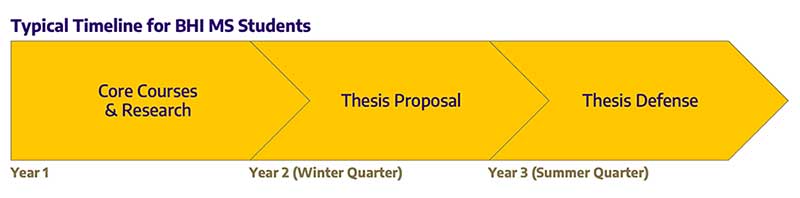
All requirements for the MS degree must be completed within six years of starting the program, including any quarters spent on leave.
Summary of PhD Degree Requirements
- Total of 90 credits minimum, of which 60 must be taken prior to scheduling the General Examination, and 27 are 800-level Dissertation credits over a period of at least three quarters
- Only courses graded 2.7 and above will count toward the degree
- All course requirements as stipulated by the program with a minimum cumulative GPA of 3.25 and minimum quarterly GPA of 3.0
- Doctoral dissertation and defense
All degree requirements above are expected to be completed according to BHI’s Satisfactory Progress Guidelines, including a Quarterly Student Progress Report. Students can track their degree using the PhD Degree Plan of Study (for students entering the program in 2027 and later) or MyPlan (requires UW NetID).
PhD Degree Milestones
- The Qualifying Exam: After completing required BHI program core coursework, students must pass a qualifying exam that covers breadth of knowledge prior to formally creating a PhD supervisory committee and proceeding with dissertation research.
- Doctoral Supervisory Committee: Students choose a BHI Core faculty member to chair their dissertation supervisory committee. The committee guides and mentors students and evaluates their dissertations.
- The General Exam: Scheduled after passing the Qualifying Exam and forming the doctoral supervisory committee, successful completion of the General Exam results in admission to candidacy for the doctoral degree. Enrollment in Dissertation credits (BIME 800) may begin in the quarter of or following successful completion of the General Exam.
- The Final Exam (Dissertation Defense): Candidates for the PhD must present a dissertation demonstrating original and independent investigation and significant achievement in the field of Biomedical and Health Informatics. The final oral exam includes a presentation and defense of the dissertation to the Supervisory Committee, and may include presentation to Biomedical and Health Informatics faculty and students, and public, in accordance with Graduate School regulations.
Timeline for PhD Completion
Students typically complete the BHI PhD program in four years, following this general timeline:

All requirements for the PhD degree must be completed within ten years of starting the program, including any quarters spent on leave.
Electives
Graduate students must also take a number of electives to reach the required number of credits to graduate (60 credits for MS, 90 credits for PhD). The electives below are just examples. Some students also utilize their elective credits to earn a Data Science specialization. Students with a strong academic computer science background can choose to utilize their electives to earn an Advanced Data Science specialization.
Example electives outside BHI:
- BIOST 544 Introduction to Biomedical Data Science
- BIOST 546 Machine Learning for Biomedical and Public Health Big Data
- CHEM E 599 eScience Community Seminar/Big Data Seminar Course
- CSE 442 Data Visualization
- CSE 512 Data Visualization
- CSE 517 Natural Language Processing
- CSE 527 Computational Biology
- CSE 544 Principles of Database Systems
- CSE 546 Machine Learning
- CSE 583 Software Development for Data Scientists
- DATA 515 Software Development for Data Science
- EPI 555 Statistical Methods For Spatial Epidemiology
- HIHIM 405 Introduction to Health Data Analytics
- HSERV 584 Assessing Outcomes in Health and Medicine
- HSMGMT 514 Health Economics
- HSMGMT 552 Health Administration and Business Law
- INSC 543 Value Sensitive Design